Showing posts with label music technology. Show all posts

10/11/23

Music in Action: Grieg Research School


For PhD candidates, post-docs, postgraduate students and senior researchers ... the GRS Autumn Course Music in Action will run from November 28-30, 2023. The event is organized by the Grieg Research School in Interdisciplinary Music Studies and is hosted by The University of Agder. 


Also, I am pleased to mention that as of a few weeks ago I am now serving on the GRS Board, which was part of what brought me to Norway over a decade ago. I am glad this promise has been kept, and I now have an opportunity to contribute to GRS as expected.


Link to event announcement: 

https://www.uib.no/en/rs/grieg/163696/music-action


INVITATION 

Music in Action


The theme of the course is 'Music in Action' and will explore the ways in which music acts in complex social, cultural, educational, and historical contexts. Music in Action invites presentations on how musical practices encounter and engage with society. The meeting points between artistic and scholarly approaches to research in music – such as applied or practice-based research – is of particular interest. An overarching question for the call is How can research in and with music can understand, analyse, and even initiate musical practices that act in complex social, cultural, educational, and historical contexts?


The course will feature presentations and discussions convened by researchers from key research groups/projects based in UiA's Faculty of fine arts, including researchers and topics from:

  1. Arts and social relations
  2. Art and Conflict
  3. Art & Young People
  4. Reconfiguring historical, Musical Crafts Education RHiMuCE
  5. Music, Dance, Drama - cross-artistic practices and educational discourses
  6. CreaTeMe centre of excellence at UiA

You may choose to engage in a dialogue with one or more of these groups and their areas of research in your presentations (please specify in your abstract if you wish to do so).


Specific questions to address include, but are not limited to:

  • How can research in and with music create new approaches to questions of health, social justice, and sustainability?
  • How can musical experiences and practices play a dynamic role in dealing with complex and potentially conflicting social conditions?
  • What role can/does music play in children’s and young people’s lives?
  • How can we educate musicians as socially engaged artists?
  • How can we improve, develop and discover new interdisciplinary methodological approaches to how we study and present music?  
  • How can we revitalize music pedagogy and arts education in the school of the future?

GRS courses are an interdisciplinary space that fosters critical and constructive dialogue. The format of presentations is flexible, and we invite performances, multimedia presentations, posters, panel discussions, and workshops, in addition to the usual oral presentations. Other formats that utilize our fields and ways of doing and disseminating research in music are also welcomed.


CALL FOR PAPERS

Abstracts are welcomed from any Ph.D. Candidates, Post-docs, Masters’ students, supervisors and researchers from any institution. The event is free for all registered participants.

Deadline for abstracts is 12th October. Follow this link to submit an abstract:

https://skjemaker.app.uib.no/view.php?id=15634751


ECTS CREDITS 

Ph.D. candidates can gain 3 or 5 ECTS credit points for active participation during this course and have the option of presenting on the main theme of the course OR on their own research project. These presentations will receive feedback from senior researchers and peers. 


REGISTRATION 

Registrations are now open. Follow this link:

https://forms.microsoft.com/e/mGEwGSTHCW


5/10/22

Conference in Estonia Funded

UPDATE (9 September 2022): Click here for an important update on this course, which will now be offered in a different location:  https://sociomusicology.blogspot.com/2022/09/nordic-network-2022-course-in-bergen.html

It is a pleasure to announce that Nordplus (Nordic governments) has just confirmed it will fund the upcoming Nordic Network for Music Education (NNME) conference and Master course in Estonia (24-28 October, 2022). The course is titled Challenges of Digital Tools in Music Education (an extension of the NNME project Digital Competence and Digitized Musical Heritage) and will be hosted by The Viljandi Culture Academy, University of Tartu, Estonia.

Master students from 19 partner institutions across all eight Nordic and Baltic countries can participate in the course’s online activities, and selected students will receive a travel grant covering all expenses to participate in person at the course site in beautiful Viljandi, Estonia.

An inspiring documentary film was made about last year’s NNME course in Iceland, and a recent book shows what NNME has achieved across its 25 years of professionalizing music education in the NB8 countries. Further information will be available soon on the website of the Nordic Network for Music Education.


Image source: https://en.wikipedia.org/wiki/Viljandi#/media/File:Viljandi_panoramic.jpg


3/11/22

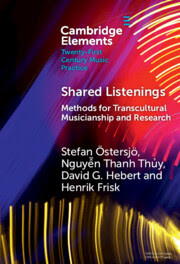
Shared Listenings Book

Our complete manuscript has been submitted to Cambridge University Press for the book Shared Listenings: Methods for Transcultural Music Performance and Research. The book is co-authored by Stefan Ostersjo, David Hebert, Thanh Thuy Nguyen, and Henrik Frisk, and is an outcome of the Musical Transformations project in Vietnam, which was led by Prof. Stefan Ostersjo.


In addition to his chaired professorship in Sweden, Stefan is now affiliated with the GAME research group as our Professor II for artistic research in music. Thuy is also currently a Swedish Research Council-funded Postdoctoral Researcher affiliated with the GAME research group. Henrik is a full professor of composition at the Royal Swedish Academy of Music in Stockholm.


With the aim of creating “a decolonized methodology - for both music performance and research,” in this book we “demonstrate how a combination of stimulated recall and collaborative autoethnographic strategies can be applied to artistic and scholarly work at the intersection of ethnomusicology and practice-led research.”


3/10/22

Documentary Film: Geysers and Guitars


Click above (or HERE) to access the 2022 documentary film Geysers and Guitars: A Music Course in Iceland, which was developed by Italian filmmaker Ferrucio Goia for the Nordic Network for Music Education

This video shows the kind of work we have been doing each year with our state-funded intensive Master courses for music teachers across the 18 institutions with Master programs for music teacher education in the eight Nordic and Baltic countries.

The film demonstrates how global competence can be developed through internationalization of teacher education programs, in this case with a music focus.


10/26/21

East African Education and Doctoral Supervision

I look forward to participating soon as a session chair and discussant for the first East African Teacher Education Symposium: Challenges and Opportunities in Teacher Education (November, 2021). This initiative was developed through the Norad-sponsored CABUTE project, and will take place both online and physically at Makerere University, in Kampala, Uganda. Eight presentations at this symposium - around half of what was selected for this event - are concerned with music-related topics, including papers by accomplished scholars such as James Isabirye, Nicholas Ssempijja and Milton Wabyona.

It was also a pleasure to learn yesterday that I have been formally appointed by the Royal Danish Academy of Music as a doctoral supervisor for a dissertation through Aalborg University concerned with online music learning between Denmark and China. It promises to be a very interesting project, and this means that I will soon have served on doctoral committees for universities in 11 countries, each of which has been uniquely stimulating. Later this week I teach for University of Bergen’s annual university-wide course on Doctoral Supervision, and next week I will be in Iceland for the NNME intensive course/conference. 


Although the pandemic has made international initiatives more challenging than before, it is encouraging to see that many forms of collaboration are still possible.


Image of Makerere University retrieved from: https://commons.wikimedia.org/wiki/File:Ssetendekero_Makerere.jpg

9/1/21

Music Learning Technology in Reykjavik


The 2021 Master course/conference of the Nordic Network for Music Education “Music Learning with Digital Technologies” is scheduled for early November in Reykjavik, Iceland. Here is the announcement, which as of yesterday indicates this event will be both in person for those who can travel to Iceland and online for those who cannot: https://sites.google.com/view/nnme-2021/home

This Nordplus-sponsored course is hosted by Adam Switala and Helga Rut Gudmundsdottir, and will likely include participants from the major music teacher education institutions in all eight Nordic and Baltic countries. We will have many presentations of ongoing Master student thesis projects as well as keynote speakers and various activities. I look forward to presenting some ongoing NNME projects, including COIL collaborations between classes on different continents and video interviews with both Nordic and global leaders in the field. 

Image: "Diego Delso, delso.photo, License CC-BY-SA"

8/16/21

Horizon Europe


It is fascinating to be developing a grant application for a large interdisciplinary project that brings together researchers from across all parts of Europe.

We seem to be right on schedule with a proposal that, if funded, could really make a positive difference for arts and cultural participation in Europe, especially in response to the ongoing challenges of the pandemic. 

Here are links with reports that describe recent issues faced by the cultural sector and arts professions:  

       https://ec.europa.eu/culture/

       https://www.fim-musicians.org/  

7/3/21

Oral History and Music Education in Africa


It is a pleasure to soon be giving my first presentation for the Pan-African Society for Musical Arts Education (PASMAE, Zambia, July 2021). It is part of a symposium convened by Marie McCarthy called Sounding the Past, Giving Voice to the Future: Oral History and Its Place in Music Education Research. 


My presentation is titled “Oral History Methods for Sustaining Music Heritage in Education” and the other panelists include Benon Kigozi and Milton Wabyona, in addition to Marie McCarthy and myself. 

Here is a link for more information on the PASMAE conference: https://www.pasmae.africa/ 

via GIPHY

3/31/21

Living Sounds: Democratizing and Reviving Musical Heritage


Recently I am assembling an international team of outstanding researchers to collaborate in a major pan-European project. The overall aim is to develop and test innovative approaches for online virtual experience of music to protect, preserve, restore and safeguard cultural heritage and the arts.

We seek to counteract serious threats to this sector due to the rise of digitalization and the disruptive conditions of the Covid-19 pandemic. The project will focus on tangible and intangible music heritage to develop, test, and popularize new research-based approaches to use music, not only in itself, but also to preserve, sustain and disseminate other forms of cultural heritage. We plan to also use digital collaborative strategies to revolutionize how cultural activities are funded and produced online, and thus create sustainable job opportunities within the cultural and creative industries (CCIs).

Hopefully we will manage to attract major funding for this unique project which promises to offer new approaches for cultural professions that have been negatively impacted by the recent pandemic. More information will be posted here later as project planning develops further.


Here are a few quotations from recent publications that provide some background for this project:

  • “When music is recognized as invaluable cultural heritage, entailing unique artefacts of intellectual property, new developments in this field then become acknowledged as important forms of social innovation” (Rykowski & Hebert, 2018, p.367).
  • Musical heritage in museums requires either “reimagining a form of music from the past or representing music that exists in the present, both of which entail an array of methodological issues” (Hebert & McCollum, 2014, p.71). 
  • “Virtual musicianship clearly prompts us to rethink how relationships between music and place have traditionally been conceived” (Hebert, 2018, p.5). 
  • “locating those songs on social media now serves to connect people and places through their virtual homes online” (Hebert & Williams, 2020).


-Hebert, D. G. & McCollum, J. (2014). Methodologies for historical ethnomusicology in the twenty-first century. In J. McCollum & D. G. Hebert (Eds.), Theory and Method in Historical Ethnomusicology (p.35-83). Lanham, MD: Lexington Books.

-Hebert, D. G. & Williams, S. (2020). Ethnomusicology, music education, and the power and limitations of social media. In J. L. Waldron, S. Horsley, & K. K. Veblen (Eds.), Oxford Handbook of Social Media and Music Learning. Oxford: Oxford University Press.

-Hebert, D. G. (2018). Music in the conditions of glocalization. In D. G. Hebert & M. Rykowski (Eds.), Music Glocalization: Heritage and Innovation in a Digital Age (p.1-19). Newcastle: Cambridge Scholars. 

-Rykowski, M. & Hebert, D. G. (2018). Conclusion: Toward a Theoretical Model of Music Glocalization. In D. G. Hebert & M. Rykowski (Eds.), Music Glocalization: Heritage and Innovation in a Digital Age. Newcastle: Cambridge Scholars Publishing, pp.346-374.


2/2/21

Music Talks Project


I am happy to report that the Music Talks project has just been awarded funding from the EU’s Erasmus Plus, specifically its program for Youth Education: Partnerships for Creativity

Music Talks is coordinated by the Baltic Regional Fund, and is a collaboration between the Info Front youth NGO in North Macedonia, and the Tava Muzikas Skola school in Latvia, with the Grieg Academy Music Education (GAME) research group of Western Norway University of Applied Sciences as the academic partner. 

The 2-year project will apply new technologies to guide music teachers and youth workers in strengthening their community music activities and developing a stronger appreciation for musical heritage.

Click HERE to access the project's page on Facebook.

Here is an updated project description:


The project aims to develop innovative learning materials for working with young people, using informal education contexts to develop youth skills to discuss important issues in society with music as a tool.

The material will be based on an international study on the skills of 15- to 25-year-old youths to perceive and appreciate music, revealing their views on socially important topics and describing youth willingness to participate in building society.

The project will inspire young people as it will entail music loved by young people around the world, diminishing economic and social barriers. Song lyrics, different genres of music, and influences from different cultures will spark discussions on topics such as empathy, social inclusion, civil participation, equality, personal freedom, justice, honesty, and mutual social interaction. Young people will gain a diverse cultural heritage experience by enriching themselves through personal growth.

Project ′′ Music Conversations / Music Talks ", No. 2020-1-LV02-KA22plets-YOU-003707 is funded by the European Commission Erasmus. Youth in action, which is administered by the Agency for Youth International Programs in Latvia.


9/29/20

Online Conference in Uzbekistan

It was enjoyable to give a presentation for the online conference today that was hosted by the State Conservatory of Uzbekistan, Tashkent. Musicologists joined from several countries, including Uzbekistan, Russia, Kazakhstan, South Korea, India, Norway, the UK, USA, Poland, UAE, and Kuwait. There were also brief presentations by the institution's Rectors and representatives from UNESCO.

Proceedings from this event will soon be published in Russian and English. Two of my frequent co-authors also had presentations, Jonathan McCollum and Mikolaj Rykowski (now Vice Rector at the academy in Poland), and it was very interesting to hear about recent developments in Central Asia. Click HERE to access a draft program (of which some details were later modified).  


 Международный научный семинар-конференция

«Шарк тароналари-2019»: взгляды ученых год спустя

(Перспективы развития традиционной музыки народов Востока)


8/28/20

Digitized Musical Heritage: Nordic/Baltic Event


The Nordic Network for Music Education (NNME) will be holding its annual symposium and intensive joint Master course during the first week of November 2020. This year, due to the pandemic, it will be an entirely online event, hosted virtually by Camilla Kvaal at Inland Norway University of Applied Sciences.

The theme for this year is Digitized Heritage: Sustaining Local Traditions.


via GIPHY

We have received positive responses from notable experts who will serve as invited speakers for this online NNME event, including prominent researchers based in Australia, China, Kenya, Germany, and elsewhere. This unique event will also feature Nordic and Baltic keynote speakers and projects, and ongoing thesis research developed by the Master student participants.

Some parts of the event will be live-streamed for open access. Participation for full credit (with presentation of ongoing research and commentary) is limited to 21 Master students, but additional students may participate in a virtual poster session with access to the keynote speeches.

Click HERE for the main homepage of the Nordplus-sponsored Nordic Network for Music Education (NNME), and HERE for the 2020 intensive course announcement.

Click HERE for the NNME entry on Wikipedia. The network includes the postgraduate programs for music teacher education across the eight Nordic and Baltic countries, and for more than 20 years it has been coordinated by the music programs at Western Norway University of Applied Sciences. 

David Hebert


via GIPHY

8/12/20

Oxford Handbook of Social Media and Music Learning


It is a pleasure to announce the publication of the Oxford Handbook of Social Media and Music Learning, a unique new research resource that promises to attract much interdisciplinary interest. It is edited by three scholars based in Ontario, Canada: Janice Waldron, Stephanie Horsley and Kari Veblen. 

My chapter in this handbook is co-authored with Sean Williams, and titled “Ethnomusicology, Music Education, and the Power and Limitations of Social Media”. Sean and I describe how the fields of ethnomusicology and music education have made creative use of various forms of social media, including blogs such as this one. Moreover, we demonstrate how the field of music as a whole has been profoundly transformed through recent technological developments in ways that are both positive and negative for artists, researchers, educators, and the general public.


via GIPHY

7/5/20

A Quarter-Million Visitors


It has now been over 13 years since I started posting various activities and announcements on this website, which across time has turned into a kind of digital portfolio. It is hard to believe, but according to statistics from the host Blogger, by mid-Autumn I am projected to have had a total of over 250,000 visitors to Sociomusicology. Those numbers are much larger than I would have ever expected, but some of the traffic might be "bots" rather than real live humans.

The very first post on Sociomusicology was about visiting Kyoto, Japan, in 2007 to complete research for my first book, while working as a young Assistant Professor at Boston University. As I would later write, just a few months afterward, it was a pleasure to have such activities as playing trumpet in Boston for Honkfest with Charlie Keil and Reebee Garofalo, and with bluesman Lou Pride in Victor Coelho’s great band. I was also excited about the work of my doctoral students, as well as the landmark Tanglewood-II symposium, but by the end of the year I left for a new job as a full professor in Finland, and eventually ended up in Norway.

Since 2007, there have been so many developments and activities that I could never have imagined. Those who have done any online writing in a blog, or related medium, will know that it can be difficult to decide what to write (and what to leave out), and inevitably issues arise across years in one’s older posts, such as broken links, formatting changes, and images that are no longer online. Meanwhile, the technology keeps evolving, especially across more than a decade. With time, I have gradually started to include more videos and photos, but never felt the need to have much interactivity built into the site. I figured that if people were curious about something they read, they could always just send me an email, and indeed, there have been many messages from strangers. I regret that sometimes I have been so busy that it has taken a while to reply.

Today most online activity is centered on proprietary social media that emphasize instant interaction and enable “big data” analytics for targeted advertising and surveillance: Facebook, Twitter, Instagram, TikTok, etc. Nevertheless, I think it still remains useful to maintain a site with one’s own content, something to link to with relative autonomy, so Sociomusicology will probably keep going for a while longer.

Displayed above are various systems that humans use to represent numbers, as well as a bit of time-lapse photography taken a few days ago from beside my home as mist was drifting across the lake.

6/11/20

Music in the Age of Streaming


The timely conference Music in the Age of Streaming will be held as scheduled next week, but offered entirely online due to the Covid-19 pandemic. Click HERE for details regarding our presentation on Networked Performance in Intercultural Music Creation.

The presentation reports on an innovative project developed by artistic researchers: guitarist Stefan Östersjö, Vietnamese dan tranh master Than Thuy Nguyen, and composer Henrik Frisk, while my own role has been to provide an empirical research (ethnomusicological) perspective. The project Networked Performance in Intercultural Music Creation is producing some exciting outcomes that I think will improve understandings of online musical interaction, including streaming technologies.

The application of digital technologies in ethnomusicology and music education is a topic I have long been researching (for more than a decade). Below are some publications in this area from just the past five years, two of which are in collaboration with talented students from Norway, while others are with accomplished colleagues at universities in the US, China, and Poland:

  • Xie, J. & Hebert, D. G. (2020, forthcoming). Establishment of an Innovative Higher Education Initiative in Beijing: The Open Global Music Academy 「全球开放音乐学院——在北京建立一个创新高等音乐教育机构的计划」. In R. Allsup, (Ed.), Proceedings from New Directions for Performance and Music Teacher Education: A Symposium on University Music Education in China (Xiamen University).
  • Hebert, D. G. & Williams, S. (2020). Ethnomusicology, Music Education, and the Power and Limitations of Social Media. In Janice Waldron, Stephanie Horsley, & Kari Veblen (Eds.), Oxford Handbook of Social Media and Music Learning. New York: Oxford University Press.
  • Brudvik, S. & Hebert, D. G. (2020). What’s stopping you?: Impediments to incorporating popular music technologies in schools. Journal of Popular Music Education, 4(2). 
  • Husby, B. V. & Hebert, D. G. (2019). Integrated Learning of Music and Science: Reception of Björk’s Biophilia Project in the Nordic Countries. In D. G. Hebert & T. B. Hauge, (Eds.), Advancing Music Education in Northern Europe (pp.222-246). New York: Routledge/Taylor & Francis.   
  • Hebert, D. G. & Rykowski, M. (Eds.), (2018). Music Glocalization: Heritage and Innovation in a Digital Age. Newcastle: Cambridge Scholars Publishing. 
  • Ruthmann, A. & Hebert, D. G. (2018). Music Learning and New Media in Virtual and Online Environments. In G. McPherson & G. Welch (Eds.), Creativities, Technologies, and Media in Music Learning and Teaching, an Oxford Handbook of Music Education, volume 5 (pp.254-271). Oxford: Oxford University Press (updated edition of 2012 publication).
  • Hebert, D. G. (2016). Editorial Introduction: Technology and Arts Education Policy. Arts Education Policy Review, 117(3), 141-145 (“Technology” Special Issue). 


3/21/20

Social Distancing and Scholarship


Ironically, the “social distancing” encouraged under pandemic conditions may actually create good conditions for some kinds of scholarship, with fewer distractions for those who are trying to complete projects. Under stressful conditions, it helps to have something meaningful to focus on while we wait for life to return to normal. 

Recently I am making a lot of progress on a book co-authored with Prof. Jiaxing Xie entitled On Music Education: East-West Dialogues (Shanghai Education Press, forthcoming), and have been developing new volumes for the Deep Soundings series in historical ethnomusicology (Rowman & Littlefield press). Several postgraduate students are making great progress on their theses, which I mentor through videoconferencing, and my institution has agreed to offer a new PhD course entirely online, for which I am now preparing material. We are also having students develop music performance projects through online collaboration tools, which is likely to be very useful experience for them in the long term. 

Over the past two months, I have completed reviews of articles and books for several refereed journals and academic presses: Music Education Research, World of Music, International Journal of Music Education, Research Studies in Music Education, Finnish Journal for Music Education, Research and Issues in Music Education, Nordic Yearbook for Music Education, Amsterdam University Press, Lund University Press, and Rowman & Littlefield. I have also approved some final edits to an article in Journal of Popular Music Education, sent a book proposal to Harvard University Press, and completed much work on a new book proposal for Rowman & Littlefield.

It seems we should always try to make the most of whatever conditions arise. Hopefully the pandemic will not turn out to be as bad as feared, but for now it is certainly threatening and great caution is warranted.

UPDATE: Online PhD Course in May 2020:
Click HERE for PhD-911: Non-Western Educational Philosophy and Policy.

2/3/20

Music Sustainability Education


Through the Nordic Network for Music Education, we have agreed on a new project for documentary videos and educational website production. This will lead toward development of an international joint Master program in Music Sustainability Education. Click above or HERE to see a sample video with further information. 

We are hopeful that support and funding can be obtained from various sources to ensure high quality outcomes for this innovative project. 

Here is a link to the Nordic Network for Music Education:

Here is a link to the new book from the Nordic Network for Music Education:

Click HERE and HERE for examples of supporting research.

2/1/20

Networked Performance in Intercultural Music Creation


I look forward to a unique conference presentation in June 2020, in partnership with some innovative musicians who are also prolific artistic researchers: guitarist Stefan Östersjö, Vietnamese dan tranh master Than Thuy Nguyen, and composer Henrik Frisk

Our presentation will be part of Music in the Age of Streaming: Nordic Perspectives, International Association for the Study of Popular Music (IASPM-Norden) conference, Pitea, Sweden (June 15-17, 2020).

Below are a few key points concerning our upcoming presentation, entitled Networked Performance in Intercultural Music Creation:
  • Streaming technology is increasingly popular as a way of consuming music recordings, but it can also be used to facilitate live collaboration among performers who are geographically distant. 
  • This panel demonstrates how networked performance may contribute to the sustaining of cultural heritage among migrant/minority communities as well as to the development of innovative intercultural artistic practices. 
  • The panel discussion of networked performance builds on preliminary findings from Musical Transformations, an ongoing research project at the intersection between ethnomusicology and artistic research in music. 
  • The panel discusses findings from Musical Transformations which may contribute new insights into creative processes in intercultural contexts, and promises to have important implications for educational and cultural institutions. 

1/27/20

Harvard Music Preference Project


It has been a great pleasure to spend some time in Boston, where I am collaborating with a brilliant professor in Harvard's school of public health for development of a new project on public music appreciation and wellbeing. We have a novel plan for a series of research projects that promise unique insights into how musical understanding and participation can be more widely developed through new technologies.

Ideally, our project may help to broaden appreciation of music connected to cultural heritage, and possibly encourage a wider swath of the public to regularly listen to, and participate in, traditional genres that are less impacted by the tendencies of commercialization. This seems quite important in both North America and Scandinavia, where audiences for traditional music are dwindling. I will post more details here in the future as the project develops further. 

It is hard to believe it has been more than a decade since I left my job as an Assistant Professor at Boston University to begin working in Northern Europe. It was very enjoyable to visit Boston again.