Showing posts with label finland. Show all posts

4/28/19

Funding Received by Nordic Network for Music Education


We are pleased to report that the Nordic Network for Music Education (NNME) has just been awarded full funding for this year from the Nordic government Nordplus program to support its intensive international Master course and exchange of Master students and lecturers across the 8 Nordic and Baltic countries. 

We are very thankful to Nordplus for a 44% increase on our budget from the previous year, which we will use wisely to ensure a strong future for music education in Northern Europe. Click HERE for more information on the NNME.

Our project for 2019 is entitled Digital Competence and Digitized Musical Heritage. This new project extends on the 20+ years of NNME history documented in our new book on Routledge, Advancing Music Education in Northern Europe.

Click HERE for more information on the book.


10/27/18

Nordic Network for Music Education 2018 Master Course


The Nordic Network for Music Education will soon offer its 2018 intensive Master course, with a conference near Helsinki, Finland: Pushing Borders: Beyond Traditional Venues of Music Education. This year the program includes participants from six Northern European countries.


Link to information about the conference site, a villa near the Jean Sibelius estate called Kallio-Kuninkala: http://www.kuninkala.fi/

Link to information about the Nordic Network for Music Education: https://www.hvl.no/en/collaboration/nordic-countries/nordic-network-for-music-education/

Link to book developed through the Nordic Network for Music Education: https://www.routledge.com/Advancing-Music-Education-in-Northern-Europe/Hebert-Hauge/p/book/9781138486263


8/15/18

Music Education in Northern Europe


Another book to be published soon . . .

Advancing Music Education in Northern Europe (edited by David Hebert and Torunn Bakken Hauge; Routledge, in press) tells the story of a unique organization that has contributed in profound ways to the professional development of music teachers in the Nordic and Baltic nations. At the same time, the book offers reflections on how music education, and approaches to the training of music teachers, have changed across recent decades, a period of significant innovations. In a time where international partnerships appear to be threatened by a recent resurgence in protectionism and nationalism, this book also more generally demonstrates the value of formalized international cooperation in the sphere of higher education. The setting for the discussion, Northern Europe, is a region arguably of great importance to music education for a number of reasons, seen for instance in Norway’s ranking as the ‘happiest nation on earth’; the well-known success of Finland’s schools in international-comparative measures of student achievement; how Sweden has grappled with its recent experience as ‘Europe’s top recipient of asylum seekers per capita’ and Estonia’s national identity as a country born from a ‘Singing Revolution’, to name but a few examples. The contributors chronicle how the Nordic Network for Music Education was founded and developed, document its impact, and demonstrate how the eight nations involved in this network – Norway, Iceland, Denmark, Sweden, Finland, Estonia, Latvia, and Lithuania – are making unique contributions of global significance to the field of music education.

Link for more information:


2/8/17

Advancing Music Education in Northern Europe


[Update, March 1, 2018: Here is a link to the book listing on the Routledge website: https://www.routledge.com/Advancing-Music-Education-in-Northern-Europe/Hebert-Hauge/p/book/9781138486263]

A unique book is now nearing completion that will show how music education has evolved with innovative approaches across recent decades in the Nordic and Baltic countries. This is a major outcome of projects affiliated with the Nordic Network for Music Education

Advancing Music Education in Northern Europe: Twenty Years of the Nordic Network for Music Education (forthcoming, Routledge/Taylor&Francis) is edited by David Hebert and Torunn Bakken Hauge, and we now have several outstanding contributing authors, including Kristi Kiilu (Estonia), Mara Marnauza (Latvia), Jolanta Lasauskiene (Lithuania), Marja Heimonen (Finland), Tiri Bergesen Schei (Norway), Geir Johansen (Norway), Eva Saether (Sweden), Cecilia Ferm-Almqvist (Sweden), Lars Brinck (Denmark), Helga Rut Gudmondsdottir (Iceland), and many more

UPDATE (January 28, 2018) - Below is the Table of Contents for our book:


TABLE OF CONTENTS

Introduction: Advancing Music Education in Northern Europe 
Torunn Bakken Hauge & David G. Hebert

Master seminars in music education across eighteen years: Inclusion, equality and democracy as lived experience  
Cecilia Ferm Almqvist

Reflections on research collaborations: A call for Nordic research on music education, sustainability, and democracy
Eva Sæther & Adriana Di Lorenzo Tillborg

Musical performance and tacit self-censorship
Tiri Bergesen Schei 

Music, universality and globalization: Some challenges for music education in the decades to come
Geir Johansen

An Icelandic perspective on the Nordic music education community
Helga Rut Gudmundsdottir

Musician and teacher: Higher popular music education in a Danish perspective 
Lars Brinck

Advancing music education via Nordic cooperation: Equity and equality as central concepts in Finland
Marja Heimonen & David G. Hebert

Bridging the past, present and future in Estonian music education: Development of the music content in National Curricula, 1991-2016
Anu Sepp, Urve Läänemets & Kristi Kiilu

A paradigm shift in Latvian music teacher education: A selection of research experience in the period, 2008 – 2017 
Mara Marnauza & Sanita Madalane

Music teacher education challenges: National and international perspectives in Lithuania
Jolanta Lasauskiene

Emotional Imitation Method in the Context of Lithuanian Music Education 
Lolita Navickiene, Asta Rauduvaite, Giedre Gabnyte, David G. Hebert 

Integrated Learning of Music and Science: Reception of Björk’s Biophilia Project in the Nordic Countries
Bård Husby and David G. Hebert 

Conclusion: Learning from Two Decades of Music Education Leadership  
David G. Hebert & Torunn Bakken Hauge 


7/12/12

Research on Music Policies and Practices in Europe


Below are abstracts for some of my upcoming collaborative publications:


Hebert, D. G. & Heimonen, M. (2013, January; Draft in review for special issue on “Cosmopolitanism and Policy”). “Public Policy and Music Education in Norway and Finland,” Arts Education Policy Review, Vol. 114, No. 1.


Public Policy and Music Education in Norway and Finland

David G. Hebert and Marja Heimonen


Abstract

Our previous research has examined the legal bases for music education in Northern Europe as well as the role of music among ethnic minorities and in the construction of national identity.  Extending on previous work, this article applies the Toulmin argument model of rhetorical analysis—which features identification and dissection of the components of prominent enthymemes—to scrutinize concepts within both educational policy documents and relevant music education literature from Norway and Finland across the past decade. Our analysis will produce a detailed account of how understandings of “music education” are formulated through the rhetoric of public policy, enabling rigorous examination of relationships between the prospective limitations of these formulations and the actual concerns of music teachers evident in professional periodicals since the start of the 21st century.  


…………………………………………………………..


Hebert, D. G., Kallio, A. A., & Odendaal, A. (2012, in press). “Not so Silent Night: Tradition, Transformation and Cultural Understandings of Christmas Music Events in Helsinki Finland,” Ethnomusicology Forum, Vol. 21.


Not so Silent Night: Tradition, Transformation and Cultural Understandings of Christmas music events in Helsinki Finland

David Hebert, Alexis Anja Kallio and Albi Odendaal

Abstract
The aim of this study was to investigate the characteristics of Finnish joulumusiikki (Christmas music) concerts and sing-alongs as well as participants’ motivations for attending these immensely popular events. Contemporary joulumusiikki events were studied through ethnographic observations and interviews conducted at five prominent Christmas music venues in the capital city, Helsinki. Findings highlight how these events may be understood as rituals that both maintain traditions and mediate the transformations of contemporary Finnish society. Joulumusiikki events were determined to provide opportunities for particularly Finnish celebrations of distinctively Finnish ideals. Thus, both as expressions and constructions of ‘Finnishness’, joulumusiikki events are seen as an important social tradition that continues to evolve and transform. With very little previously published research on such topics, this study offers preliminary but important insights into the role of Christmas music events in Finnish society which are highly significant due to their powerfully affective connection to cultural heritage and the fact that more than a fifth of Finns (around 1 million) participate in them annually.


10/3/10

Music Psychotherapy Among Refugees

The doctoral defense of Sami Alanne will be held on October 23, 2010 at the Sibelius Academy in Helsinki, Finand. His dissertation, entitled "Music Psychotherapy with Refugee Survivors of Torture: Interpretations of Three Clinical Case Studies," documents his own music therapy interventions with three immigrant men living in Finland who originally came to Europe from nations in Central Asia, the Middle East, and West Africa. This study combines qualitative observations with data from psychological tests and even factor analysis of events recorded from therapeutic sessions. Alanne originally began his dissertation under emeritus Professor Kai Karma. I worked intensely with Alanne at the Sibelius Academy as his main supervisor across the 2009-2010 academic year, but left Finland for a job in the USA as Alanne was sending out the completed document to reviewers for critique. He will graduate with Sibelius Academy's Lauri Vakeva as his Chair and renowned Norwegian music therapy expert Evan Ruud as the "opponent" reader. I anticipate that Alanne's study will be of great interest to music therapists in multicultural nations who seek to more effectively serve patients from immigrant backgrounds, particularly those who have been traumatized by warfare and other dehumanizing conditions.

5/25/10

Master of Global Music Program Set to Begin


On Friday, the last of the auditions for the new Nordic Master of Global Music program were completed. The following audition dates were offered for applicants who passed the first phase of the GLOMAS admissions process:


It was encouraging to see several outstanding students apply to the GLOMAS program, with an especially large number at the Sibelius Academy. Auditioning students came from a wide variety of musical and cultural backgrounds, including a flamenco guitarist with experience playing the Arabic oud, a Kurdish-Swedish saz player, a Danish singer and dancer who has lived in Ghana, a Danish avant garde trumpeter with experience in Indian music, a Tanzanian drummer and dancer, a Finnish harpist-songwriter, a Swedish-Finn who plays Brazilian percussion, a Slovenian violinist, and a Finnish kantele player, to mention but a few. The admissions decisions will all be formally announced within the next few weeks.


Part of my job at the Sibelius Academy in recent years has been to coordinate the development of this new program, including its curriculum and admissions/auditions process. As of this week, the preparatory work will finally all be complete and the new program will be fully ready to be launched in August. It was exciting to serve on the adjudication panel at each of these three institutions during the past few weeks, and to see first-hand the broad range of talented musicians interested in this new international-collaborative joint Master program.


More details regarding this new program are described in the following open-access publication:

Hebert, D. G. (2010). Educating professional musicians for a multicultural society: Emerging issues and new developments. In proceedings of Orally Transmitted Music and Intercultural Education, symposium offered by EU Culture Initiative Music, Orality, Roots, Europe (MORE) at Cité de la Musique, Paris, France (December 3-4, 2009) [http://www.music-orality-roots.eu/sites/default/files/MORE-Symposium1-HebertD-EducatingProfessional.pdf].


Below is more information regarding this program, as explained on the Master of Global Music (GLOMAS) program website:


The Master of Global Music (GLOMAS) is a joint study programme offered in collaboration between higher education music academies in three nations: Royal Academy of Music (Aarhus, Denmark), Lund University, Malmö Academy of Music (Malmo, Sweden), and Sibelius Academy (Helsinki, Finland). The programme leads to a Master degree according to each institution’s regulations and national legislation. GLOMAS is a highly innovative, interdisciplinary programme that is responsive to new needs arising from globalization in the field of music. The programme emphasizes development of “bimusical” performance skills (typically within at least two traditions from different parts of the world), as well as studies of topics relevant to the career of a professional musician, including such areas as musical leadership and instructional skills, project management, and applied research.


Graduates from this Master degree programme will demonstrate:

(1) a high level of comprehensive musicianship that transcends cultural boundaries,

(2) knowledge of both traditional and contemporary hybrid music genres, in and outside of Europe,

(3) an ability to effectively lead music ensembles, communicate and teach music across a diversity of formal and informal settings, and

(4) an ability to successfully develop, document and manage intercultural music projects.


The GLOMAS programme seeks to play a transformative role at the level of both individual students and Nordic society, by broadening musicianship and enhancing both intercultural understanding and lifelong music learning, inside and outside of schools. This new postgraduate program seeks to foster innovative forms of intercultural musicianship, and is inspired partly as a response to music globalization, as well as the rapidly changing student demographics in urban schools within the Nordic region.


Click here for further information: http://glomas.net


4/23/10

20th Anniversary Choir Concert


Helsinki chamber choir Kampin Laulu, which specializes in music by contemporary composers, will be offering its 20th anniversary concert tomorrow evening.


Terve Maria is the title of the concert, at the Vanha Kirkko (Old Church, central Helsinki), 24 April, 2010, starting at 7pm. Tickets are 20 euros. The program features major choral works such as Einojuhani Rautavaraa’s Magnificat and Benjamin Britten’s Hymn to Saint Cecilia, as well as the premiere of a new composition by Kampin Laulu’s conductor Eric-Olof Söderström. There will also be some shorter pieces by Part and Brahms.


I am singing the lowest bass parts with this choir, which has released numerous CDs in recent years. Here is a link for further information about Kampin Laulu:

http://www.kampinlaulu.fi/


2/26/10

Master of Global Music Deadline


The 2010 application deadline for the Master of Global Music (GLOMAS) program is nearly here.


This joint study program offers the unusual opportunity to study for a Master degree in the field of world music at institutions in three different European nations. The program also provides opportunities to learn about the contemporary music industry and to conduct field work studies in Africa and the Middle East through the Glomus Network for higher music education.


Please see the following website for further information:

http://glomas.net/


1/30/10

Music of the Baltic


Today the Helsinki harbor is frozen over, and here is a photo I took of it just this morning. I heard that the Baltic Sea is frozen across even to Estonia nowadays, which is hard to imagine. Around 100 million people currently live in the Baltic Sea area, which has been an important region of cultural exchange for centuries.


Here are links for more information about the Baltic Sea region:

http://www.baltic.com/default_start.asp

http://www.euroregionbaltic.eu/


Here is a link to the Baltic Association of Music Academies, which has been active since 1995 in the promotion of musical exchange among music schools in this region: http://www.abambaltic.net/


Here is a link to an announcement for the upcoming Baltic Musicology Conference, which has as a theme “The Baltic Sea Region in the 21st Century”:

http://www.iamic.net/international-news/42nd-baltic-musicology-conference


12/17/09

Joulu Choral Concert


Tonight is the final Joulu performance of Helsinki chamber choir Kampin Laulu. The festive concert is 7pm at Kellokosken Kirkko, in the greater Helsinki area.


A variety of choral pieces will be performed, ranging from traditional English madrigals to Finnish Christmas carols.


I sing the lowest bass parts with the choir.


Here is a link to the Kampin Laulu website:

http://www.kampinlaulu.fi/


11/16/09

Intensity of Interaction in Instrumental Music Lessons


Congratulations to Dr. Tapani Heikinheimo for completion of his doctoral degree at the Sibelius Academy, with the acceptance yesterday of his academic dissertation Intensity of Interaction in Instrumental Music Lessons.

Here is a link to the study:

http://ethesis.siba.fi/ethesis/files/nbnfife200911162351.pdf


Here is its abstract:


Previous research on one-to-one instrumental music lessons in higher education has shown asymmetrical relations between teachers and students and an emphasis on expression and technique in both implicit and explicit strategies of teaching and learning. In order to rethink the practice of instrumental and vocal pedagogy, to better understand such multivoiced musical and pedagogical interactions and to enhance musicianship, this study introduced and examined intensity as a relational phenomenon and as constituting a factor in interaction between teacher and student. Intensity of Interaction offers an overview of the dynamic character of the musical and pedagogical dialogue. It aims to encompass both instrumental lesson activity as a whole, and to reveal detailed elements of the teacher-student work. In order to theoretically frame and conceptualize the instrumental music lesson as a teaching and learning activity, the present study draws on pragmatist philosophy and cultural historical activity theory. The following twofold question guided the study:

How does Intensity of Interaction constitute musical and pedagogical meaning construction in instrumental or vocal teaching and learning and to which features of verbal and musical communication is Intensity of Interaction connected?

This study gathered data during a period of 3 years, through interactive processes and events in 22 lessons, using observations, video and audio recordings, field notes, intensity ratings, and stimulated recall interviews. The analysis viewed the data from two parallel perspectives on the lesson interaction. The first perspective considered meaning construction in the lesson activity. The other perspective entailed interpretation of the intensity ratings, that is, the perceived meaningfulness of joint musical engagement. The analysis combined these two empirical sources of information in the framework of Activity Theory.

The study and the analysis of the data consisted of the following phases: (1) formulation and testing of methods for analysis of Intensity of Interaction based on the intensity ratings and the Method of Voices from the field of Activity Theory, (2) determination, through application of this theory and method, of ways that music teaching and learning strategies arise through internal contradictions within various forms of a) musical play, b) narrative play, and c) knowledge inquiry, (3) development of a description of the theoretical construct Intensity of Interaction as a key component of the teacher/student dialogue in music lessons.

As an outcome, the increased awareness regarding meaning construction and diversity of problem solving in music lessons has implications for both instrumental pedagogy and future research. Firstly, the results showed how Intensity of Interaction is related to teaching and learning strategies. Secondly, Intensity of Interaction highlights qualitative elements in teacher-student work, which create musical and personal growth and development. Thirdly, the findings of this study challenged the paradigm of efficiency, in which efficiency of teaching is related to high teacher intensity and inefficiency related to low teacher intensity in instrumental instruction. Fourthly, Intensity of Interaction is comprised of the continuity of tension between sense making and awareness of musical reality, sense making and conventional meaning, and musical-pedagogical concepts versus musical-pedagogical reality.

Articulation of the contradictions facilitates change as an outcome of relations in which the two polarities are not exclusive but are brought into accord through a dialogical process. Consequently, Intensity of Interaction opens up prospects of development in lesson content and structure. In all, this study highlights the sensitive nature of the teacher-student interactions and the pragmatic value of Intensity of Interaction in educating musicians and in developing the teacher-student work. This suggests the usefulness of Intensity of Interaction as a tool for self-observation and teacher education, elaborating more reflective teaching and learning contexts within instrumental pedagogy.


Congratulations to Dr. Tapani Heikinheimo!


It was a pleasure to serve as co-supervisor of Tapani's doctoral dissertation, along with activity theory expert Ritva Engestrom and music education philosopher Heidi Westerlund.


10/16/09

Choral Concert by Kampin Laulu


MERI (The Sea)
Kampin Laulu Chamber Choir
Cafe Jugend, Pohjoisesplanadi 19, Helsinki, Finland.
Saturday, 7th of November, 2009, at 4pm.
Tickets: 8.00-12.00 EUR

The sea will serve as the theme for the Kampin Laulu Chamber Choir's upcoming concert, featuring both old and new chamber choir music, mostly by Nordic composers:
Kuula - Nevanlinna - Segerstam - Vainio - Vidjeskog - Whitacre.
Conductor: Eric-Olof Söderström.


I sing the lowest bass parts with the choir. Here is a link to their website:

http://www.kampinlaulu.fi/en/


10/9/09

Two European Doctorates in Music

Two of the doctoral students I have been advising are nearly complete with the revisions to their theses, and will soon be giving their final doctoral presentations and graduating from the Sibelius Academy, in Helsinki, Finland:


-Tapani Heikinheimo (completion on 15 November 2009, Sibelius Academy): Intensity of Interaction in Instrumental Music Lessons (co-supervisor)


-Arnold Chiwalala (completion on 9 November 2009, Sibelius Academy): Chizentele: My Path to Original Artistry and Creative Fusion of Ngoma with Finnish Folk Music and Dance (co-supervisor)


Tapani Heikinheimo is the student with whom I have worked the most since coming to Sibelius Academy more than one year ago. His study offers new insights into the dynamic process of teaching and learning in one-to-one instrumental music lessons. Tapani’s other supervisors are activity theory expert Ritva Engestrom and music education philosopher Heidi Westerlund.


Arnold Chiwalala is a unique musician who has written an autobiographical and reflective thesis on his own artistic development as a renowned Tanzanian-Finnish songwriter, musician, and intercultural performing artist. His study offers new insights into issues in intercultural artistic development. Chiwalala’s other examiner is Finnish folk music expert Hannu Saha, and committee members include Heikki Laitinen and Alfonso Padilla.


It has been a great pleasure to work with such outstanding musicians and scholars, and I am certain both Tapani and Arnold will continue to make a difference in the field of music.


6/8/09

Summer is Here


The first week of June has ended, and the days are becoming incredibly long in the Nordic region while the academic year is finally drawing to a close. Today, one of the doctoral students who I have worked with in Helsinki this year Ari Poutiainen was awarded his doctoral degree at Sibelius Academy for successfully defending a dissertation entitled Stringprovisation: A Fingering Strategy for Jazz Violin Improvisation. The dissertation is now published on the Acta Musicologica Fennica Series, as volume 28 (Finnish Musicological Society, ISSN 0587-2448). According to the external reviewer, Norwegian violinist Dr. Stig Roar Wigestrand, there appears to have never before been such a thorough study on the topic of jazz violin technique. I think this dissertation also effectively demonstrates the possibilities of artistic research as a methodological approach in the field of music.

For the rest of this summer I will be advising Arnold Chiwalala and Tapani Heikinheimo as they also make the final revisions to their doctoral dissertations in order to graduate from Sibelius Academy in September 2009, and I anticipate some of my doctoral students from Boston University finishing shortly as well.

I am leaving Finland soon to give lectures in Belfast and London, followed by a summer-long research residency at Nichibunken in Kyoto, Japan. The trip to the UK is sponsored by a grant from the QUB Internationalization Fund, acquired and coordinated by Suzel Ana Reily at Queen's University, Belfast. Above is a photograph taken by my sister Christina the last time I was in the UK, which was surprisingly bright in April (hence the squinting). On that trip, I presented a paper at the Research in Music Education (RIME) conference in Exeter, with the kind support of the Martta Sihvola Foundation. After that conference we very briefly visited Buckingham Palace, which contains many iconic reminders of the complicated legacy of colonialism, but the palace gardens were quite impressive, which is where this photo was taken. I am eager to visit the UK again, and look forward to talking with several very interesting music scholars there, including Suzel Ana Reily, Trevor Herbert, and Lucy Green.

3/6/09

Music in Nordic Institutions


The start of 2009 has been quite busy.

During the past two months I have had lectures and/or meetings at the following institutions:


  • Orebro University, Orebro, Sweden

http://www.oru.se/templates/oruExtIntroPageLevel2____4965.aspx


  • Rhythmic Music Conservatory, Copenhagen, Denmark

http://www.rmc.dk/en.html


  • Bergen University College, Bergen, Norway

http://www.hib.no/english/


  • Grieg Academy, University of Bergen, Norway

http://www.hf.uib.no/grieg/05english/start.htm


  • Norwegian Academy of Music, Oslo, Norway

http://www.nmh.no/english


  • University of Helsinki, Finland

http://www.helsinki.fi/university/


It is inspiring to see various new developments in the field of music at higher education institutions across the Nordic region. With the exception of Iceland, the Nordic region seems to have been less affected by the global economic downturn than most other parts of the world (and despite some very recent trends, might turn out to be as resilient as India), but even here there is increasing concern for the efficiency and financial viability of universities that will likely lead to further restructuring of national educational systems. Music continues to be valued and supported, with new approaches to performance, pedagogy, curriculum and research that may rightfully be regarded as “cutting edge” and innovative in a global context.


Here is a link to an insightful report from 2004 by Marja Heimonen that describes Nordic music conservatories:

http://www.nkinfo.org/files/Nordic%20Music.pdf


[I recently took the above photo of this statue of Grieg near his former residence in Bergen, Norway.]


11/10/08

Nordic Research in Music Technology


In 2009, the Nordic Network for the Integration of Music Informatics, Performance and Aesthetics will hold a week-long masters-level course in Esbjerg, Denmark:


http://www.sdu.dk/~/media/Files/Om_SDU/Institutter/Ifpr/Cynthia/MIPA.ashx

I am giving a lecture and interactive workshop there on new music technologies in Japan and the USA.

Recently, I am also designing a proposal for a multi-national research project on the use of new music technologies in targeted urban centers of Europe, Asia, and North America.


11/1/08

Kampin Laulu and Panula


Last night I sang for a recording session with the Kampin Laulu Chamber Choir at Jorma Panula’s house. We recorded Panula’s recent choral works for small men’s chorus. Panula is one of Europe’s most respected conducting pedagogues, and his former students serve as conductors for several of the world’s leading symphony orchestras and choirs. Panula’s new works feature attractive harmonies and textures – a challenge to sight read, but well worth the effort. I have been singing as a member of Kampin Laulu for about 2 months, and we have concerts coming up in a few weeks.

Related websites:

http://en.wikipedia.org/wiki/Jorma_Panula

http://www.jormapanula.com/

http://www.kampinlaulu.fi/


At its next concert, Kampin Laulu will perform some very attractive and interesting new choral pieces by Finnish composer Tapani Lansio: http://www.fimic.fi/fimic/fimic.nsf/mainframe?readform&lansio+tapani

More information on Finnish music may be obtained from the Finnish Music Information Centre:
http://www.fimic.fi/fimic/fimic.nsf/naviframe?readform&f=mic1f3.htm&m=5.1&ct=0


10/10/08

Globalisation and Identity in Music Education

In mid-November 2008, the Sibelius Academy Music Education Department will be hosting the conference Globalisation and Identity in Music Education.


Click HERE for the programme of this event.


Professor Lucy Green (University of London) will be one of the keynote speakers.


Click
HERE for a programme of the related event for school music teachers, Classroom Rock Band as a Learning Environment.

This conference is offered with the generous support of Nordplus through the Pan-Nordic coalition of advanced music institutions Musikkpedagogisk Nettverk: Nordic Network for Music Education.
http://www.hib.no/studier/internasjonalisering/program/Musikkpedagogisknettverk.htm


Click
HERE for a link to the 2009 Nordic Network conference now being planned in Sweden.


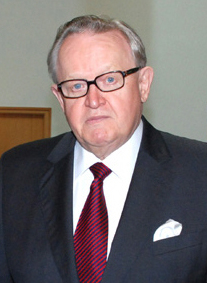
Finland’s former President Wins Nobel Peace Prize


Today the 2008 Nobel Peace Prize was awarded to a former President of Finland Martti Ahtisaari.


Click here for further information:
http://www.iht.com/articles/2008/10/10/healthscience/11nobel-fw.php

In addition to his work as a leading peace negotiator, Ahtisaari is the major patron of international music projects through the MIAGI (Music Is A Great Investment) program.

Click here for further information:
http://www.miagi.co.za/about.html