7/2/22

PhD Dissertation on Chinese Students at European Universities


Congratulations to Chinese music educator Dr. Youdi Sun on completing her PhD defense at Vytautas Magnus University in Lithuania.


It was a pleasure to serve on the examining committee yesterday.


Dr. Sun’s dissertation, directed by Prof. Jolanta Lasauskiene, is titled Adjusting to Cultural Differences in Teaching and Learning: The Case Study of Chinese Postgraduate Students in Lithuania.


Dr. Sun submitted a thorough and rigorous study that demonstrates great potential for becoming a highly accomplished researcher. I am hopeful she will manage to attain a postdoctoral position.


Recent media articles on Chinese students in western higher education:

https://www.insidehighered.com/news/2022/05/20/peak-chinese-students-could-come-five-years

https://www.bbc.com/news/uk-scotland-60587499


6/20/22

ISME world conference online


This is an exciting time for music educators, as the meeting of the largest organization in our field—the ISME world conference—is approaching in mid-July, hosted virtually from Queensland, Australia. For this meeting, I will be giving presentations in three sessions, one of which I will chair/organize.


“Seeing Through a Wider Lens: Revisionist History in Music Education,” Chair: Craig Resta. Panelists: Marie McCarthy, David Hebert, Benon Kigozi. 

Abstract

Looking at historical events is one way to better comprehend how prior actions can influence future progress. Often our narratives about the past have been framed through certain lenses that may not reflect the realities of the time, or the perspectives of today. As a result, there are people and histories and happenings that have untold stories needing more attention.  A primary idea of this panel is to discuss definitions of revisionist history, why it matters, and innovative approaches to understanding who we are, how we move ahead, and how to make progress towards social justice as dialogue and practice in the field. 

 Examples might be women in music education, international perspectives, LGBT issues and music teaching, marginalized populations, ethnicity and race, sociocultural influences connected to musical experiences, critical pedagogies and practices, cultural understandings, and diversity and pluralism in numerous settings. Others may be technology aspects, policy, reform, and institutional protocols, nationalism and musicological studies, and so on. Further viewpoints include how historical events play out in our profession, examples from the literature, and potential impacts on music teaching and learning in multiple countries and circumstances. This participatory discussion will tackle these issues representing viewpoints and perspectives from North America, Europe, Middle East, Scandinavia, Africa, and Asia. Scholars on the panel include those from the United States, Ireland, Norway, Israel, and Uganda. While more history needs to be done generally in music education, there can be even more attention to ideas and people and happenings that many of us do not know today. Aside from the historical events themselves, is the important discussion of history, and how we think and do it in practical context. What is our purpose in historical inquiry and reflection, and how can the outcomes make the musical experiences of those around us better?


“Musical Communication with China: An International Dialogue,” by Jiaxing Xie and David Hebert

Abstract: 

How does music enable intercultural communication and dialogue in education? From a traditional Chinese perspective, music is composed of three levels: form, function, and metaphysical dimensions. Musical communication and dialogue are thereby believed to originate from these three levels, which may serve as a framework for understanding interactions with the West. By the year 1600 Mateo Ricci had performed western music in China, but it was only since the 1840s that Western music began to profoundly influence Chinese music culture with varying intensity according to the evolving sociopolitical situation. Across generations, Chinese musicians have actively participated and reflected on the three delineated levels, but after nearly 200 years of intensifying musical “communication” how much do most Western people understand about Chinese music, even during this “information age”? We will examine specific cases of interaction between Chinese and Western musicians that have sought to improve intercultural understanding, and reflect on ways of evaluating the educational and social impact of such endeavors. Our account will take into consideration the arguments of notable Chinese international relations scholars, including Xiaoying Qi and Yaqing Qin, as well as perspectives of musicologists from China and other countries. One important development in this area was the establishment of institutions for learning Chinese musical instruments in Europe, but we note that enthusiasm for Western music in China has generally been stronger than enthusiasm for Chinese music abroad. When it comes to musical collaboration between China and Norway, for instance, we identify specific phases of development (e.g. 2000-2009, 2010-2019, etc.). In our view, robust intercultural exchange in music requires not only performances and symposia, but also in-depth dialogues, including co-authored publications of the kind that we are developing across years of collaboration.


“Ready to Conduct Historical Research?: Dialogue with Mentors.” Chair: David Hebert; Panelists: Marie McCarthy, Jane Southcott, Phillip Hash, Benon Kigozi, Robin Stevens, Craig Resta, and Casey Gerber 

Abstract: 

The purpose of this meeting is to provide an open session for mentoring of early-career scholars and doctoral students. All ISME participants interested in historical research in music education are warmly welcomed to the session for discussion of their project concepts. Distinguished historians and mentors have agreed to participate in this session, including Marie McCarthy, Jane Southcott, Phillip Hash, Benon Kigozi, Robin Stevens, Craig Resta, and Casey Gerber. The session is chaired by David Hebert. The mentors will offer advice regarding previous studies as well as appropriate theoretical and methodological approaches. In addition to an opportunity for mentoring, this meeting also offers a chance to discuss future projects of the ISME History Standing Committee. 


Public domain image from: 

https://en.wikipedia.org/wiki/Didgeridoo#/media/File:Didgeridoo_(Imagicity_1070).jpg 

6/14/22

International Education PhD in Lithuania


Congratulations to Chinese music educator Dr. Yuqing Yang on completing her PhD defense at Vytautas Magnus University in Lithuania.


It was a pleasure to serve on the examining committee today.


Dr. Yang’s dissertation, directed by Prof. Jolanta Lasauskiene, is titled Boundary Crossing: The Socio-cultural Integration Experience of Chinese International Students in Lithuania.


6/10/22

Inequalities in Higher Education and Arts

We are now in the middle of a unique international PhD course at Bergen Summer Research School called Global Inequalities in Higher Education and the Arts. Below is my introductory video for the course, which is co-taught with geographer Erlend Eidsvik.

We have outstanding guest lecturers appearing in this course, including Emily Achieng’ Akuno, Tara Pandeya, Alexis Kallio, Lesley Le Grange, Suriamurthee Maistry, and Nasim Niknafs.


PhD Candidates have joined the course from universities in many different countries—including South Africa, Nigeria, Cameroon, Australia, India, Canada, Norway, Denmark, Sweden, and UK—including students who originally come from such places as China, Indonesia, Russia, Georgia, and Spain. 


Below is a link for Emily Akuno's keynote speech: 

https://youtu.be/K3eh4NusheY  


I look forward to seeing the long-term outcomes of this course, and the PhD summer school as a whole, including the likelihood of some joint publications.

5/10/22

Music Diplomacy Book Published

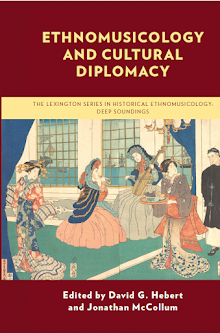
Volume II of our Deep Soundings book series has just been published: Ethnomusicology and Cultural Diplomacy. This book includes contributors from many countries across the world who seek to show how music projects are used to generate intercultural understanding, empathy, and reconciliation.

For me, the need for a book on this topic became clear when I was invited for an interview feature in a Geneva-based magazine for diplomats called DIVA International Diplomat (published in 2020, p.18-20). But cultural diplomacy matters far beyond the specialized sphere of ambassadors and professional diplomats, since it encompasses an array of artistic and social activities, sometimes even focused on relations between nations (or ethnicities) within a single state. Cultural diplomacy, we argue, is also relevant for teachers at all levels of schooling who seek to find innovative ways of internationalizing their student’s experiences for a richer quality of education.

During the writing of this book, our contributors faced an array of complex challenges, from severe Covid lockdowns to violent conflicts, including the Taliban’s takeover of Afghanistan, volatile unrest in Hong Kong, and a catastrophic civil war in Tigray, Ethiopia. Our contributing author from Ethiopia disappeared in the chaos after sending us parts of his chapter, and following many months of concern we are still unable to confirm whether he survived. War is the opposite of what most kinds of music participation aim to cultivate. We hope this book will help generate new ideas for how peaceful relations and mutual respect can be fostered through music. 

It is taking a while for the book to be internationally distributed, so we will plan a book launch event for sometime in August or September.  


Conference in Estonia Funded

UPDATE (9 September 2022): Click here for an important update on this course, which will now be offered in a different location:  https://sociomusicology.blogspot.com/2022/09/nordic-network-2022-course-in-bergen.html

It is a pleasure to announce that Nordplus (Nordic governments) has just confirmed it will fund the upcoming Nordic Network for Music Education (NNME) conference and Master course in Estonia (24-28 October, 2022). The course is titled Challenges of Digital Tools in Music Education (an extension of the NNME project Digital Competence and Digitized Musical Heritage) and will be hosted by The Viljandi Culture Academy, University of Tartu, Estonia.

Master students from 19 partner institutions across all eight Nordic and Baltic countries can participate in the course’s online activities, and selected students will receive a travel grant covering all expenses to participate in person at the course site in beautiful Viljandi, Estonia.

An inspiring documentary film was made about last year’s NNME course in Iceland, and a recent book shows what NNME has achieved across its 25 years of professionalizing music education in the NB8 countries. Further information will be available soon on the website of the Nordic Network for Music Education.


Image source: https://en.wikipedia.org/wiki/Viljandi#/media/File:Viljandi_panoramic.jpg


5/8/22

Projects in Late Spring 2022


After almost three weeks of Covid, it is quite a relief to have - finally - nearly recovered. There is a lot to catch up on, and we will soon get back on track with several projects, including some book chapters with the GAME research group, a proposal under development by the Royal College of Music, planning of the next NNME course, PhD admissions decisions for the CABUTE project, and hosting of the EU-funded Music Talks project in May in Bergen. And, after that: Bergen Summer Research School.

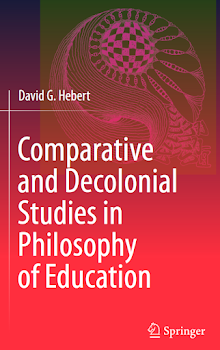
We will also move to completion of my tenth book, an edited volume on an exciting topic with implications for education, international relations, and the arts: Comparative and Decolonial Studies in Philosophy of Education. It has been a pleasure to work on this project with a new generation of promising scholars from around the world, and we are delighted to include a Foreword by a brilliant internationalist colleague Koji Matsunobu, and even an Afterword by renowned educational philosopher Yusef Waghid. It looks like we can still manage to submit the book to Springer press approximately as scheduled, in July 2022, just a few weeks before my fiftieth birthday. We are quite hopeful that this book will inspire teachers with a global view and new ways of approaching education. Below is the Table of Contents.


COMPARATIVE and DECOLONIAL STUDIES in PHILOSOPHY of EDUCATION


Table of Contents

Foreword

                        Koji Matsunobu

Preface

                        David G. Hebert

Introduction: Why comparative and decolonial studies in philosophy of education?  

David G. Hebert


Chapter 1        Cai Yuanpei and aesthetic education in modern China

Ning Luo and Tao Guan        


Chapter 2        Self-reflection, East and West: Educational implications of Kyoto School versus Humboldtian Bildung approaches

                        Miwa Chiba


Chapter 3        Ki Hadjar Dewantara and philosophy of education in Indonesia

Dorothy Ferary


Chapter 4        Philosophy of education in the Philippines: Virgilio Enriquez and Sikolohiyang Pilipino

Czarecah Tuppil Oropilla, Charla Rochella Santiago-Saamong and Jean Guadana


Chapter 5        Beyond education: A balanced perspective embodied in Tagore and Hu Shih’s educational philosophies

Lexuan Zhang and David G. Hebert


Chapter 6        Lessons from ubuntu for moral education

Pip Bennett


Chapter 7        Omoluabi and Asabiyah philosophies: Afro-Arabian perspectives on inclusive education policy in Nigeria

Abass Bolaji Isiaka


Chapter 8        The “happy island” of Polish music education: Self-Orientalization of educational philosophies in post-Soviet Europe

                        Adam Switala and Piotr Majewski  


Conclusion: Advancing and applying comparative and decolonial studies in philosophy of education 

Pip Bennett, Dorothy Ferary, and David G. Hebert


Afterword 

Yusef Waghid

………………………………………………………