1/3/22

Resilience in European Higher Education


UPDATE (10 December 2022): Click HERE for the project announcement at our university in Norway. 


UPDATE (14 November 2022): Here is a link to the RESUPERES project website: https://resuperes.ugr.es/


Happy New Year, 2022! It is a pleasure to announce that we will soon have EU funding to be part of the RESUPERES research project to examine resilience in the higher education sector amidst the pandemic in Portugal, Italy, Serbia, Spain, and Norway. 

The RESUPERES project promises to develop new insights into how characteristic behaviors of resilience can be meaningfully instilled in university students involved in various fields, including music and sports which often require physical spaces that are difficult to approximate online. 

Project Partners: 

*UNIVERSIDAD DE GRANADA (Spain) 

*UNIVERSIDADE DO ALGARVE (Portugal) 

*UNIVERSITA DEGLI STUDI SUOR ORSOLA BENINCASA (Italy) 

*UNIVERZITET U BEOGRADU (Serbia) 

*WESTERN NORWAY UNIVERSITY OF APPLIED SCIENCES (Norway)

University of Granada is the lead institution for RESUPERES, and the Norway coordinator for this project is Prof. Coral Falco. 

We also await the results of other grant applications that may generate hopeful new insights for heritage sustainability in these complicated times.  

More detailed information and links will be posted here later in 2022.


via GIPHY

12/1/21

Music Activities in Early 2022


UPDATE: The proceedings from this conference, with my keynote speech, can be downloaded for free by clicking here and going to the bottom right of the next website: https://www.ifmpf.hmtm-hannover.de/de/publikationen/forschungsberichte/forschungsbericht-33/


In late January 2022, I look forward to giving a conference opening speech for the third German-Dutch Colloquium on Research in Arts Education in Hannover, Germany. The theme for this government-sponsored event is “Multiculturalism in Music and Drama Education,” and it is hosted by Prof. Andreas Lehmann-Wermser, a prolific researcher who heads the Institute for Music Education Research at the Hannover University of Music, Drama and Media. 


The host institution, which has been in operation for over 120 years, offers comprehensive studies (including in jazz and popular music), and has produced many influential musicians, some of whom originally came from East Asia. The city of Hannover itself has also long played an important role in Germany, from its roots as the home of Gottfried Leibniz to today as the headquarters of Volkswagen. Among the more notable scholars to have come from Hannover (Linden-Limmer borough) is Hannah Arendt, whose work has seen a profound impact across recent generations in philosophy and social theory.


Depending on the status of the pandemic, this event will either be held face-to-face or online only. Click HERE for more information on the colloquium. 


This colloquium is generously supported by the Rat für Kulturelle Bildung (Counsel for Cultural Education) and the Federal Ministry of Education and Research (BMBF). It is hosted by the Hochschule für Musik Theater und Medien Hannover. 

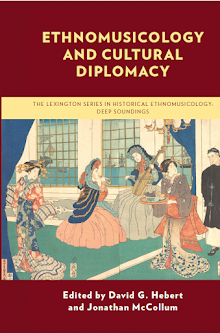
In the late winter and spring, if the Covid pandemic allows for it, I am expected to make trips to Riga, Copenhagen, Prilep, and Kampala for various music research and writing projects. Due to the Omicron variant of Covid-19, it looks increasingly doubtful whether much travel will be possible, so probably in most cases we will have to continue with online cooperation until the pandemic is less of a concern. In March we will focus on further data collection for a book on Viking musical heritage for Bloomsbury press, and by around that time we expect to see two more volumes published in the Deep Soundings series, volume II on music and cultural diplomacy, and volume III on traditional Malaysian court music.


In April, I will give a plenary address in Lithuania as a scientific committee member of the conference Music and Science Labyrinths at Vilnius University-Siauliai Academy. This partly online event celebrates the achievement of musicologist Eduardas Balčytis, who played a central role in the establishment of formal music pedagogy in Lithuania.  


There are also some new developments in East Asia to report: It was exciting to see the work of Prof. Qi Kun of China Conservatory, published in a new edition of the journal Chinese Musicology. Qi is an accomplished researcher who serves as Editor-in-Chief of the journal Chinese Music, and her recent work concludes that many recommendations from our book Theory and Method in Historical Ethnomusicology are particularly relevant to music scholarship in China. When travel becomes possible, I plan to continue developing several projects in various parts of China. 


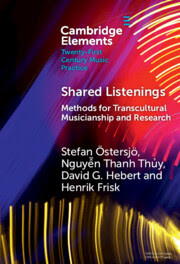
The Grieg Academy Music Education (GAME) research group has also nearly completed our co-authored chapter on music education in Norway for a book edited by Prof. Masafumi Ogawa to be published in Japan by Minerva Shobo press. In mid-January, I have meetings scheduled to continue developing the book Transcultural Musicianship and Research: Methods for Shared Listening and Performance (forthcoming, Cambridge University Press), which is being co-authored with a team of music researchers and performers from a project in the Mekong Delta of Vietnam.


11/27/21

Visiting Professor in Music (Artistic Research)

We are very pleased to announce a new visiting professor (Professor II) will be affiliated with the Grieg Academy Music Education (GAME) research group over the next two years (2022-2024):


Stefan Ostersjo is known internationally as a guitarist and innovator in the application of artistic research methods to musical topics. Author of the book Listening to the Other, he specializes in intercultural music projects and interpretation of contemporary music, and frequently collaborates with composers and improvisers in experimental music projects. His research is published in Contemporary Music Review, Studies in Musical Theatre, Swedish Journal of Music Research, Frontiers of Psychology, and other journals.


Image sources:

https://en.wikipedia.org/wiki/Singing#/media/File:Lorenzo_Costa_-_Un_concerto_(National_Gallery,_London).jpg

https://en.wikipedia.org/wiki/Ten-string_guitar#/media/File:ViolaDaMano_Raimondi_c1510.jpg

Visiting Professor in Music Education (Psychological Research)


We are very pleased to announce a new visiting professor (Professor II) will be affiliated with the Grieg Academy Music Education (GAME) research group over the next two years (2022-2024):

Helga Rut Gudmundsdottir is known internationally for her work on singing in early childhood, parent-infant singing, and music reading. Her research is published in such journals as Psychology of Music, Music Education Research, and Musicae Scientiae, and she co-edited volume II of the Routledge Companion to Interdisciplinary Studies in Singing. She is also the founding CEO of Tonagull, an Icelandic research-based music workshop method that is becoming popularized and exported to other European nations. 


Image source: https://en.wikipedia.org/wiki/Choir#/media/File:54-aspetti_di_vita_quotidiana,_canto_in_chiesa,Taccuino_Sani.jpg

11/23/21

Understanding and Addressing Inequality

The 2022 Bergen Summer Research School, on the theme of Understanding and Addressing Inequality, will include our new PhD course Global Inequalities in Education and the Arts.


Click HERE for more information.


The deadline is February 1, 2022.


Music in a Concussive Monologue

The latest issue of Voices: A World Forum for Music Therapy contains an article inspired by reflections on a complex experience from about five years ago. We believe it may be useful for those who study music cognition or who treat those with head injuries.


via GIPHY

Still image from: 

https://commons.wikimedia.org/wiki/File:PLoSBiol4.e126.Fig6fNeuron.jpg 

11/8/21

Oral History Discussions

Dr. Yang Yang at Education University of Hong Kong has just posted a brief interview based on questions that emerged in response to one of my earlier videos – “Oral History Methods for Sustaining Music Heritage in Education” – which was widely shared in China.


Click HERE to access the new Q&A session.


Click HERE to access an explanation and link to the original video (speech) that served as a basis for this Q&A session.


English versions are available on each of the above sites, but it is necessary to scroll to the bottom of each page.


Pictured above is a public domain image, a sketch of the Old Summer Palace in Beijing, where western music was often performed before the palace grounds (including concert hall) were destroyed in 1860 during the Second Opium War.