
I eagerly
look forward to visiting Amsterdam soon as an Invited Speaker for what promises
to be a unique and exciting event:
The
Global Philosophy of Education Field Launching Conference (at VU Amsterdam).
This
explanation is from its Call for Papers:
“This
conference aims to establish the field of Global Philosophy of Education,
understood as a research space and practice where central issues in philosophy
of education are defined, discussed and researched jointly by philosophers
working from different cultural and philosophical traditions and perspectives.
This entails not the establishment of a global philosophy in the sense of a
universal or hegemonic philosophical theory, but the development of a global practice
of philosophy of education.”
Here is the
abstract for the speech I have developed for this event:
Learning Beyond Borders: Seeking Synthesis in
Global Philosophy of Education
Prof. David G. Hebert
Western Norway University of Applied Sciences
Abstract
It is common in Northern Europe for
educational foundations to mostly rely on the ideas of German and Nordic
thinkers from more than a century ago (e.g. Humboldt, Grundtvig, etc). Recently,
countries that boldly deviate to some extent from this tradition, such as
Finland, tend to attract attention for their educational innovations. Still, it
seems reasonable to ask whether teacher education remains the most ethnocentric
field in all of academia. In two recent books, I collaborated with colleagues
from diverse cultural backgrounds to rethink philosophy of education from a
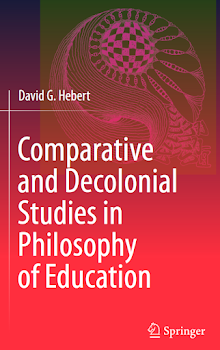
comparative and decolonial perspective. One book is an anthology that aims to
demonstrate the usefulness of efforts to challenge Eurocentrism and cultivate a
global philosophy of education (Hebert, 2023). The other is a monograph
co-authored with a Chinese scholar that aims for a synthesis between Asian philosophies,
contemporary western philosophies, and systems science, to develop a novel
philosophy of music education that is responsive to the new challenges from AI
(Xie & Hebert, 2026). Here I will share some reflections on the processes
and main ideas from these projects as well as prospects for future work. Along
the way, I will demonstrate how the field of global philosophy of education has
been quietly developing for some time, as seen in the work of luminary African
scholars like Yusef Waghid, Indigenous (Maori) scholars like Linda Tuhiwai
Smith and Carl Mika, and laudable internationalists such as Martha Nussbaum, Michael
Peters and Liz Jackson. I will also outline the benefits to be gained if European
universities would do more to promote cosmopolitan scholarship that stimulates
pedagogical reflections beyond outdated visions of Bildung, particularly in
this uniquely challenging age of AI.
Link for
more details: https://www.global-philosophy-of-education.com/


 https://orcid.org/0009-0002-1446-3893












No comments:
Post a Comment