Professional choir
Tabula Rasa will perform a series of concerts at three locations in western
Norway in mid-October, 2019. The program is entitled Peace (“Fred” in
Norwegian), and features the theme of sacred
music facing war memorials. The program is designed to stimulate reflection
on the consequences of war and whether it is enough to dream of peace.
The program features music by Orlando de Lassus, Arnold Schönberg, Arvo Pärt, Frank Havrøy, Jake Runestad, and the premiere performance of a new piece by Tord Kalvenes. This project is supported by the Norwegian Arts Council, the Norwegian Composers Association, and the Norwegian Composers Fund. Here is the schedule and other details (in Norwegian): 14. september Krigminnene på Fedje, minikonsert kl 15 Fedjekyrkja, konsert kl 17 15. september Nordsjøfartmuseet i Tælavåg, minikonsert kl 15 Sund kyrkje, konsert kl 18 22. september Herdla museum, minikonsert kl 15, 15.30 og 16. Herdla kyrkje, konsert kl 18 Musikalsk leder: Arild Rohde Sopran: Rikke Lina Sorell Matthiesen, Sigrun Jørdre Alt: Elise Thorgersen Varne, Zsuzsa Zseni Tenor: Tord Kalvenes, Arild Rohde Bass: Charles Lindberg, David Hebert Regi: Ingrid Askvik
UPDATE: This PhD course was offered entirely online in late May and June 2020. It was a great success, with very positive evaluations and strong student projects that will likely lead to publications. The course will be offered again two years later, in 2022. Please plan to join us!
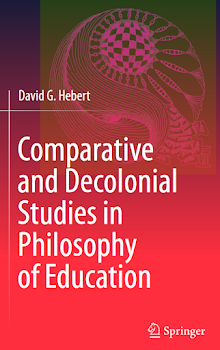
In late May 2020, we will offer a new PhD course in Bergen entitled Non-Western Educational Philosophy and Policy. This intensive interdisciplinary
course is situated within our PhD program in Bildung and Pedagogical Practices (European
educational philosophy), but it is also open to doctoral students from other universities for ECTS (European) credits.
Below is
the course description and a link for additional information.
This course enables educational theories and
practices in contemporary Europe to be more deeply understood in relation to
non-Western educational philosophies and policies. The focus of the course is
on exploring intellectual traditions and sociocultural practices that shape
school education outside of Europe, in the continents of Asia, Africa, Oceania,
and the Americas. It offers a survey of non-European philosophical writings on
education, including such major historical theorists as Confucius, Ibn Khaldun,
al-Farabi, Ibn Sina, Ibn Rushd, Ghandi, Zera Yacob, Tagore, Fanon, Nishida, Said, and Freire, as well as
intercultural observations of notable contemporary educational and social
theorists: Michael Peters, Martha Nussbaum, Nuraan Davids, Yusef Waghid, Carl Mika, Amartya Sen, Seyla Benhabib, Timothy
Reagan, Linda Tuhiwai Smith, Joel Spring, Nicholas Burbules, Carlos Alberto
Torres, Fred Dervin, Mark Halstead, and David Killick. The course will
especially emphasize discussion of East Asian schools, due to both the
distinctive philosophies and recent economic and educational achievements in
China and Japan. Students will also explore the implications of non-western
philosophical traditions for their particular school subject areas of
specialization (e.g. arts education, social studies, citizenship education,
physical education, etc.).
As discussions linked
below demonstrate, at many institutions there has been some debate surrounding
the movement to “decolonize the curriculum”, but in my view the most valid
argument for offering a course on these thinkers is that it enables us to better
understand intellectual heritage from many parts of the world, and to better
learn from each other. The course does not "replace" anything, but it certainly contributes to a more complete higher education, and stimulates us to rethink basic assumptions concerning the nature, value, and implementation of educational systems.
In late August I
will be visiting spectacular Samarkand, Uzbekistan to give a speech for the
musicology symposium affiliated with the 12th International Music Festival
Sharq Taronalari.
This year’s
symposium is called Prospects for the Development of Traditional Musical Art of the Eastern
People, and my speech, entitled “World Music Pedagogy: Presenting
Central Asian Traditions to the World”, is related to some ongoing writings for
the World Music Pedagogy
book series on Routledge.
The purpose of my presentation
is to introduce Campbell’s WMP model and demonstrate how this innovative approach
may be applied so Central Asian music traditions are effectively shared with foreign
audiences, thereby broadening global appreciation and understanding of Asian
musical heritage.
The Sharq Taronalari festival attracts extraordinarily skilled
traditional musicians from across the world, as well as prominent music festival
managers and ethnomusicologists. I am very thankful for the opportunity to be invited to this great event and look forward to meeting creative musicians from Uzbekistan and other countries.
Across the
past two weeks, PhD students from several countries joined the course I taught
for Bergen Summer Research School entitled Cultural
Policy: Arts Heritage and Sustainability. We included some excellent guest
lecturers, such as Mary Miller (Director of Bergen National Opera) and
Norwegian scholars Tore Sætersdal (anthropologist) and Ole Marius Hylland (policy analyst).
The PhD students came
from Germany, Brazil/Sweden, Canada, Ethiopia, Nigeria, Ethiopia, Ghana, and
South Africa. We are now developing a book based on these two international cultural
policy PhD courses held in 2018 and 2019.
Next week I
teach a course entitled Arts Policy in
the Twenty-First Century for law students in China’s leading law faculty, China
University of Political Science and Law (CUPL), Beijing.
In the
Autumn, a new PhD course that I developed will finally be offered in Bergen at
Western Norway University of Applied Sciences. It is entitled Non-Western Educational Philosophy and Policy.
PLEASE NOTE: PhD students from other universities are welcome to take these exciting intensive courses in Bergen -- in English -- for ECTS European transfer credits. Although
music, education, and global studies continue to be the major themes in my research and
teaching, I am increasingly interested in devising improvements to the ways
that governments support arts and cultural heritage through various kinds of
institutions.
We are pleased to report that the
Nordic Network for Music Education (NNME) has just been awarded full funding for this year
from the Nordic government Nordplus program to support its intensive international Master
course and exchange of Master students and lecturers across the 8 Nordic and
Baltic countries.
We are very thankful to Nordplus for a 44% increase on our budget from
the previous year, which we will use wisely to ensure a strong future for music
education in Northern Europe. Click HERE for
more information on the NNME.
Our project for 2019 is entitled Digital
Competence and Digitized Musical Heritage. This new project extends on
the 20+ years of NNME history documented in our new book on Routledge, Advancing
Music Education in Northern Europe.
It is a pleasure to be part of two intercultural music research panels with excellent scholars at international conferences
in Bergen and Malmo in early summer, 2019.
Panel Chair/Organizer, “Chinese Music” (with
Directors of Confucius Institutes in Norway and Denmark). Paper presentation, “Musicians’
Reflections on the Teaching of Traditional Chinese Instruments for Prominent
Conservatories in Europe and China,” Nordic
Association for China Studies (NACS) international conference, University
of Bergen, Norway (June 13-14, 2019, PLANNED).
Panelist, “Indigeneity in
the 21st century classroom: Reconstruction and reconciliation in Scandinavia
and North America” (with Eva Saether, David Johnson, Ylva Hofvander Trulsson, and Patrick
Schmidt), European
Association for Music in Schools (EAS) annual international conference,
Malmo Academy of Music, Lund University, Sweden (May 16-18, 2019, PLANNED).
Displayed is a photo I took of a lesson on
the Chinese guqin late last year.
I am pleased to announce that we will soon have a book launch for our latest book on Routledge, Advancing Music Education in Northern Europe.
The book launch will be a public event at the libary of Western Norway University of Applied Sciences, Bergen, on Tuesday April 9, 4pm-6pm.
Contributing authors representing all Nordic and Baltic countries will give presentations at the book launch. These include several of the leading scholars from the field of music education in Northern Europe. There will also be a presentation by Liora Bresler.
Click HERE to access a poster for the event.
Click HERE for more information on the book.
For nearly 20 years (since 2007), this website has offered musings on contemporary society and its music by David G. Hebert, PhD. He is a sociomusicologist specializing in global music education who has held academic positions with universities on five continents. Dr. Hebert is now a tenured full Professor with Western Norway University of Applied Sciences, Bergen. There he leads the Grieg Academy Music Education (GAME) research group and manages the multinational government-funded Nordic Network for Music Education, which organizes annual intensive Master courses and exchange of teachers and students across eight countries. He is also an Affiliated Professor with both University of the Faroe Islands and Kyambogo University (Uganda), Visiting Professor with UCSI University (Malaysia), and Honorary Professor with the Education University of Hong Kong.
Professor Hebert's research applies an international-comparative perspective to issues of pluralism, identity, and cultural relevance in music education, as well as processes by which new music traditions emerge and change - both sonically and socially - as they are adopted into institutions. Born in the 1970s, he is among the most widely-published and globally-active music scholars of his generation (h-index:23), with professional activities in an average of 8 countries per year across the past decade (2008-2020).
Keynote Speaker - Across recent years, Professor Hebert has had keynote speeches in Poland, Germany, Uzbekistan, China, Sweden, Norway, Estonia, Lithuania, Tanzania, and Thailand, and chaired two sessions at ISA-Japan.



 https://orcid.org/0009-0002-1446-3893