In November of
2014 I will be speaking for music conferences in Estonia, Norway, and the USA.
Below are titles and abstracts for the three presentations, two of which are on
research methods, while the other is on issues in the evaluation of music
lecturers in higher education.
-Roundtable Panel
Presentation at Annual Meeting of the Society for Ethnomusicology (Chaired by James Revell Carr, with panelists Jonathan McCollum, Ingrid Monson, Gillian Rodger,
Michael Iyanaga, and David Hebert):
Excavating the Subaltern Past: Theories and Methods in Historical Ethnomusicology
Abstract
As ethnomusicologists continue to grapple with the musical legacy of hundreds of years of colonialism and imperialism, more scholars are recognizing the importance of historical research in understanding a post-colonial world. The old adage tells us that “history is written by the victors,” but twenty-first century ethnomusicologists are making efforts to uncover the voices of the subaltern, the subjugated, the marginalized, and the colonized, excavating alternative histories that complicate the received understanding of the past inscribed by prior generations of scholars. Research of this sort does not simply tell us about the past, but can have important repercussions for political and social issues in the present. This roundtable will explore the possibilities and the pitfalls of undertaking historical ethnomusicology with subaltern subjects, discussing a variety of methodologies, practicalities, and theoretical frameworks that have been utilized in recent work. Panel participants represent research on a wide range of geographic areas and socio-cultural issues, including African-American vernacular music and the Civil Rights movement, devotional song for Catholic saints in Brazil, syncretic music genres of native Hawaiians, representations of gender transgression on the American popular stage, nationalism in Japanese music education, and the music of the Armenian Apostolic Church. Each of these scholars will discuss their efforts to negotiate differences between radical postmodern subjectivities and the compelling desire to understand objective, empirical “truth.” Through these disparate case studies, the panelists will propose approaches that can help other ethnomusicologists navigate the contested terrain of history and uncover obscured perspectives and previously untold narratives. [James Revell Carr, chair]
Click HERE for
further information:
-Keynote Speech
at Grieg Research School Conference:
Observational Methods in Music Research
Abstract
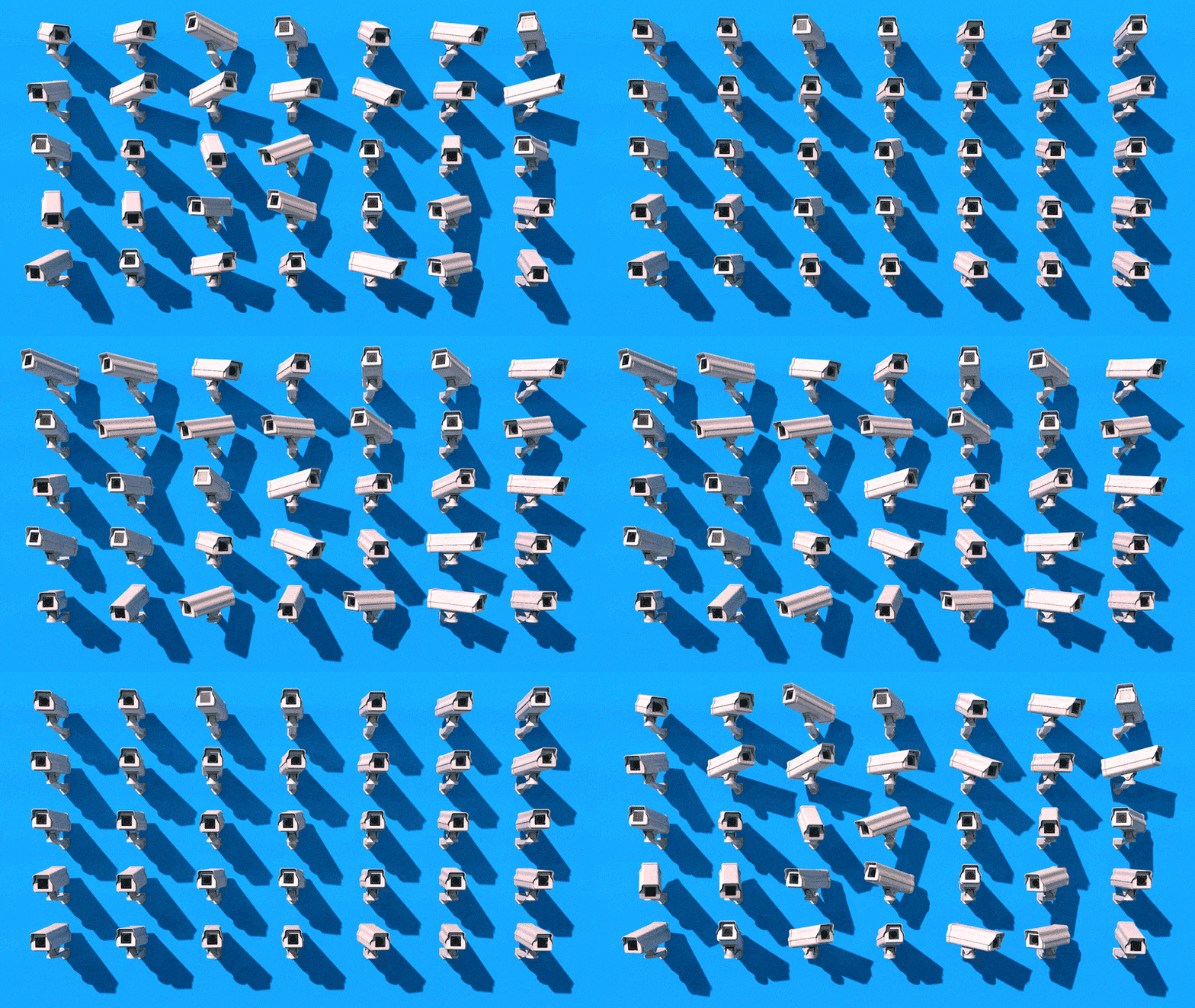
Interviewing is
often perceived as a particularly insightful and enjoyable way to conduct
research. Interviewers typically sense that they are connecting personally with
interviewees, and attaining deep insights into their world. Especially among
music scholars in the Nordic countries there is a tendency across recent years
to emphasize interview data within qualitative studies. But what of
observational methods? Has observation become passé, and no longer necessary
for the production of new musical knowledge? One perennial rationale for the
use of observational methods is the unassailable truism that “People only
sometimes say what they really think, and what they really think only sometimes
accurately reflects reality” (Hebert & McCollum, 2014, p.49).
Indeed,
consideration of systematic observations may even be necessary in order to
fully understand ourselves, enabling a healthy confrontation with biases and
inaccuracies in the explanations constructed as we strive to make sense of
musical developments in our lives (i.e. arts-based research). Empirical
observation can be conducted in various ways by music researchers, including
such approaches as ethnographic field notes and automatic recording techniques
for capturing sound, video, images, movement, or other data. Some observational
strategies require special conditions (e.g. expensive equipment in a
laboratory), while others can be conducted naturalistically: in music studios,
classrooms, or therapy settings, for example. An array of quantitative and
qualitative techniques may be used for analysis of observational data, many of
which are greatly enhanced by the convenience of recent digital technologies.
This session will combine a lecture format with various workshop activities
designed to acquaint participants with issues and strategies for observational
research. Key concepts to be demonstrated include subjectivity, delimitation
and framing, sampling, content analysis, inter-observer reliability, thick
description and “thick analysis”. We will consider common threats to the
relevance, accuracy and thoroughness of observations, and examine an array of
strategies for effective collection, analysis and interpretation of
observational data in research that advances human knowledge with new musical
discoveries.
Key questions addressed by the lecture:
-What kinds of
significant musical knowledge cannot be obtained from interviews; and
conversely, what of importance cannot be observed?
-What are some
diverse ways that observations may be collected, analysed, and interpreted in
order to produce new findings regarding a musical phenomenon?
-What are some
effective techniques for strengthening the reliability and convincingness of
observational reporting?
Click HERE for
further information:
-Keynote Speech
at Annual Meeting of Nordic Network for Music Education:
Cultural Differences and Strategies in
the Performance Assessment of Music Lecturers in Higher Education
Abstract
In most countries, assessment and
evaluation entail complex processes faced from the time young children first
enter schools until they complete advanced and professional studies as adults.
However, evaluation continues further, even through the PhD and onward, as
lecturers seek promotion in higher education careers. While effective assessment
can be a uniquely valuable tool for growth, it too often becomes an arena in
which biases and misuse of power are painfully evident. Many may assume that
standards are fairly uniform, but there is in fact enormous diversity in the
expectations and underlying assumptions that inform the practice of assessment
and evaluation in higher education. This topic appears to be little researched,
yet assessment commonly affects many of us in ways that can become quite
personal and distressing. This presentation is based on critical review of
documents (from the fields of higher education, intercultural communication,
and music education research) as well as reflection on four kinds of personal
experience: (a) managing music lecturers for New Zealand’s largest college, (b)
serving as a supervisory committee member or examiner for doctoral degrees in
various countries (USA, Canada, Finland, Norway, Sweden and Spain), (c)
assisting China Conservatory in Beijing with its development of an
international network in 2014 for collaboration between music schools (partly
for assessment purposes), and (d) evaluating music faculty as an
anonymous reviewer - mostly for tenure and promotion to Associate Professor and
full Professor - at public universities on five continents: Europe (Finland and
Iceland), Asia (Singapore), Oceania (Australia), Africa (South Africa), and
North America (public universities in Illinois and British Columbia). I will
seek to identify the types and causes of an array of common issues, and attempt
to formulate possible solutions or strategies for minimizing certain problems
largely attributable to cultural differences. It is hoped that the ideas shared
here will prompt further discussion of how assessment in higher education may
be implemented in sustainable ways that are increasingly fair and transparent
as well as effective toward the objective of nurturing artistic, pedagogical,
and scholarly excellence in conservatories, colleges, and universities.
Click HERE for
further information:



 https://orcid.org/0009-0002-1446-3893