2/19/26

Reception of Shared Listenings


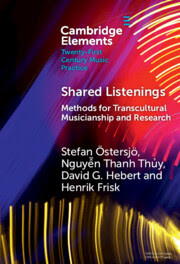
Recently some very positive reviews have been published for our co-authored book Shared Listenings: Methods for Transcultural Musicianship and Research (Cambridge University Press): 


"Shared Listenings is more than a research text; it is a guide for the "reflective practice" that every improviser should ideally undergo. The authors demonstrate that by facing the difficulty of unfamiliar contexts and sharing critical views, one reward is a deeper understanding of one's own musical behavior. This book recommends us to look at our own practices with the same scrutiny that they have employed. It asks us to consider if our learning is extractive or if it is a genuine attempt to correct unjust imbalances of power. It invites us to develop a keener sense of how to make space for others." 

Journal of Sonic Studies.

https://www.researchcatalogue.net/view/558982/4175093


“The many years of experience in tedious intercultural work that the book's authors possess (...) made it possible to present an unusually concrete text on how future musician education and artistic research in music could be developed with the help of shared listening (…) what could be called a handbook on the art of musical encounters across cultural boundaries” (translated from Swedish) 

Swedish Journal of Music Research 

https://publicera.kb.se/stm-sjm/article/view/51283/44805


2/16/26

Professional Activities in East Asia


It was a tremendous pleasure to participate as an Invited Speaker for a recent conference in Seoul, Korea hosted by the Association for Future Music Education.


Also, click HERE for a link to an update from the Global Competence Partnership project in Hong Kong.


Lately I have also been visiting Japan’s music industry capital, Hamamatsu, for development of an application to the Horizon Europe grants program. We intend to develop new research-based solutions, technological (AI) standards, and policy recommendations for specialized uses of music, as requested by a call from the EU. 


Also, here is a brief video from a jazz club in Hong Kong ... a brilliant local trumpeter named Ruel Cabrilla generously let me borrow one of his instruments to sit in on a tune in mid-February 2026 ... 


2/4/26

Music Dissertations from Denmark and the Faroes


Two talented PhD candidates have now proceeded to the final stages of their doctoral studies.


Knut Eysturstein (University of the Faroe Islands) has submitted a full draft of his dissertation, The Concept of the Faroese in Music Education: Negotiating Identity and Notions of Tradition, which will soon proceed with final edits and then be sent to the examiners. This is the first study to offer an in-depth historical and ethnographic perspective on music in the Faroe Islands. The external examiners (“opponents”) for Knut’s PhD dissertation defense, to be held in Spring 2026, have also formally accepted their appointments: music educationist Helga Rut Gudmundsdottir (University of Iceland) and ethnomusicologist Kimberly Cannady (Victoria University Wellington, New Zealand).


Recently, Marianne Løkke Jakobsen (Director of Global Affairs, Royal Danish Academy of Music) has very successfully completed her “pre-defense” at Aalborg University, Copenhagen, Denmark. Marianne has an impressive series of published articles that together demonstrate many important aspects to be considered in intercultural synchronous online teaching of musical instruments, particularly with Chinese students. She now proceeds to writing the “kappa” which links together the publications into a cohesive whole for presentation and evaluation of the entire project, offering multiple recommendations to improve music teaching and learning in conservatoires.


It has been a great pleasure to work with these fine young scholars who are generating entirely new insights for music and related fields.


2/3/26

PhD Defense on Music in Uganda


Soon, an important event to be celebrated: The PhD dissertation defense of Erisa Walubo at Makerere University, Uganda.


With studies supported by the CABUTE project, Erisa has forthcoming articles in Philosophy of Music Education Review and other journals, and has produced an impressive ethnographic study that demonstrates from a decolonial perspective how Indigenous arts traditions can be effectively integrated into education. 


It has consistently been a great pleasure to mentor Erisa, who shows enormous promise as a scholar and educator.